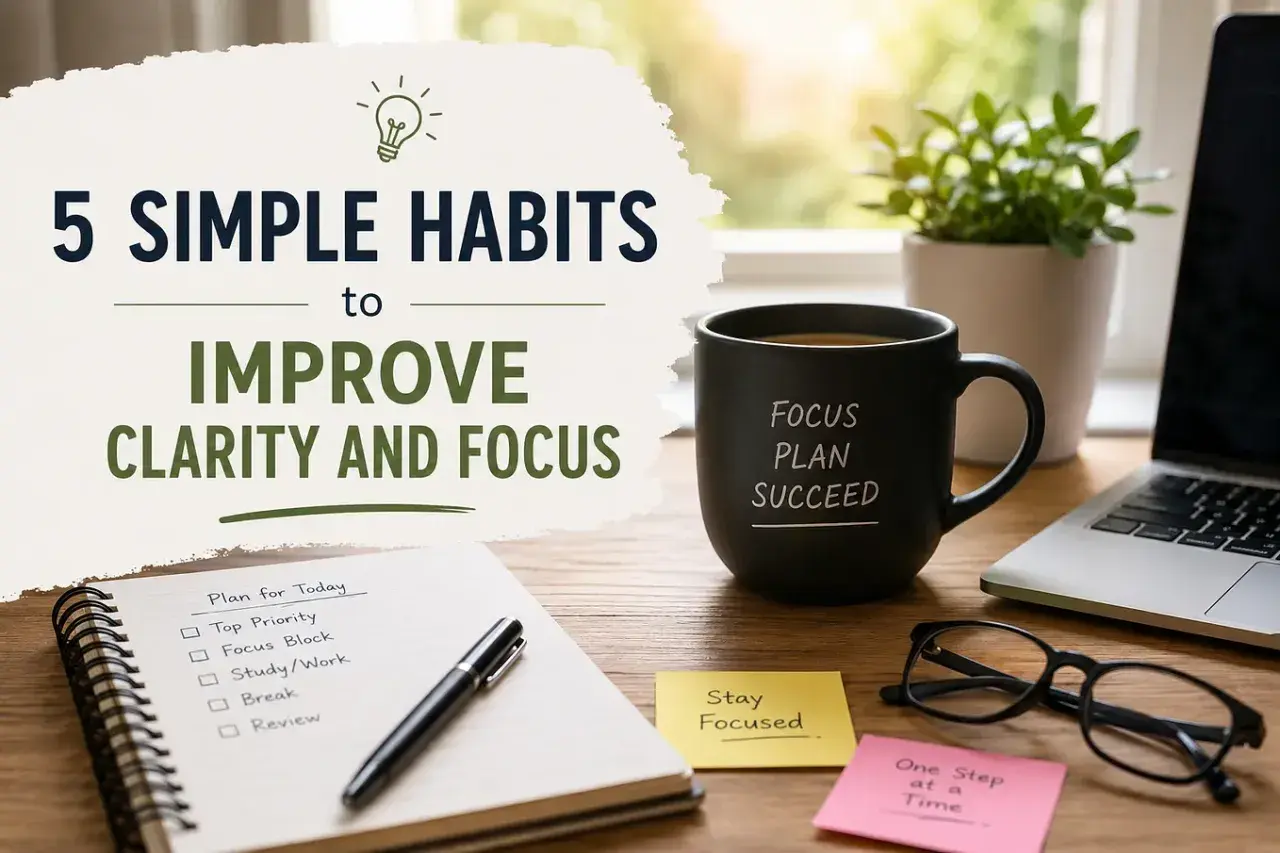
A clear mind is rarely the result of thinking harder. It usually comes from reducing open loops, noticing what you feel, and giving your attention a place to land. This guide on how to organize your mind focuses on practical ways to turn mental noise into a system you can actually use at work, in leadership moments, and in everyday life.
The core idea in plain English
- Mental clutter usually comes from unfinished tasks, emotional overload, and too much input at once.
- One trusted capture system frees working memory so you can stop relying on recall.
- Emotional intelligence helps you notice what you feel before it turns into reactivity or avoidance.
- Attention improves fastest when you cut noise, protect focus blocks, and review your day consistently.
- If overwhelm is lasting, affecting sleep, or tied to anxiety or low mood, support matters as much as structure.
Understand what kind of clutter you are dealing with
I start here because most people try to solve the wrong problem. A noisy mind can come from three different places: unfinished tasks, emotional overload, or too much input. If you treat all three as the same thing, you end up using the wrong fix and blaming yourself when it does not work.
Open loops are the easiest to spot. These are the errands, emails, decisions, and promises that your brain keeps reopening because they have not been captured anywhere reliable. Emotional overload is different: the mind is not busy because there is too much to do, but because a feeling is demanding attention. And then there is attention fragmentation, where constant switching leaves you mentally exhausted before you have done any meaningful work.
- Open loops need capture and prioritisation.
- Emotional overload needs naming, pause, and perspective.
- Attention fragmentation needs fewer interruptions and clearer boundaries.
Once you know which type of clutter is in front of you, the next step is much easier: get it out of your head before it starts looping.
Get thoughts out of working memory before they start looping
Working memory is the small mental scratchpad you use to hold active information. It is useful, but it is not built to store every task, worry, and half-finished idea you are carrying. I prefer to treat it as a temporary workspace, not a filing cabinet.
The simplest way to protect it is to use one trusted capture place. That can be a notebook, a notes app, or a task manager, but it should not be three different places with three different rules. The point is not neatness; it is trust. If your brain believes the idea will not be lost, it stops repeating it to you.
- Spend 5 to 10 minutes dumping every open loop onto paper or into one app.
- Sort each item into now, later, or waiting.
- Write the next physical action, not the whole project.
- Keep today’s active list to 3 priorities whenever possible.
That small shift is often enough to stop the mental spinning. Once the mind no longer has to act as a storage unit, you can use emotional intelligence to decide what deserves attention and what does not.
Use emotional intelligence to sort the feeling before the task
Emotional intelligence is not about being calm all the time. In practice, it is the discipline to notice what you feel, name it accurately, and keep it from hijacking your judgement. For leadership and career growth, that matters more than people admit. A stressed person can still be competent; a reactive person often looks organised while making poor decisions.
Name the emotion precisely
I find that vague labels like “stressed” or “off” are not very useful. Try more specific language: frustrated, embarrassed, resentful, anxious, disappointed, overloaded. The more exact the label, the less power the feeling tends to have. Naming it does not solve the problem, but it stops the brain from treating every sensation as an emergency.
Ask what the emotion is protecting
Every strong feeling is usually defending something important: time, status, safety, belonging, competence, or control. If a message from your manager makes you defensive, the real issue may be fear of being judged. If you keep delaying a decision, the hidden issue may be the fear of getting it wrong. That is useful information, because the real fix is different from simple time management.
Read Also: Determination & EQ - Master It Without Being Rigid
Choose a response you can still defend tomorrow
One of the most practical tools here is a thought record. The NHS version uses seven prompts to capture a situation, the thought attached to it, the feeling it creates, and the evidence for and against the thought. I like it because it creates a pause between emotion and reaction. You do not have to believe every thought that passes through your head just because it arrived loudly.
When you can separate the feeling from the task, organisation stops being mechanical and starts becoming intelligent. That is why the next step is choosing the right method for the kind of mental clutter you are facing.
Match the method to the problem you're actually facing
I do not treat mental organisation as one universal system. Some problems need capture, some need emotional processing, and some need less stimulation, not better planning. Using the right method saves time and lowers frustration.
| Method | Best for | Limitation |
|---|---|---|
| Brain dump | Too many open loops and reminders | Does not solve emotional tension by itself |
| Thought record | One worry or self-critical thought keeps repeating | Takes more effort than a quick task list |
| Worry time | Rumination that keeps interrupting the day | Only works if you keep the slot consistent |
| Time blocking | Clear priorities but weak follow-through | Fails if the calendar is overpacked |
| Weekly review | Keeping commitments from drifting | Needs 20 uninterrupted minutes |
If the tool does not fit the problem, it will feel useless. That is usually the point where people blame themselves, when they should really change the method. Once the method fits, protecting attention becomes the next job.
Protect your attention from the habits that fragment it
In a UK workday, attention is often shredded by Teams pings, email, meeting creep, and the habit of checking “just one thing” every few minutes. In leadership roles, that fragmentation is expensive because your mood, pace, and judgement leak into the people around you.
My rule is simple: reduce the number of moments when your brain has to switch gears for no good reason.
- Check email two or three times a day instead of keeping it open all day.
- Protect the first 30 minutes of the day from notifications if you can.
- Leave 10 minutes between meetings when your calendar allows it.
- Batch admin into one short block instead of scattering it across the day.
- Silence non-critical alerts during deep work, even if only for 45 minutes.
This is not about becoming unreachable. It is about making sure your best thinking is not constantly interrupted by low-value noise. From there, the real stabiliser is a reset routine you can repeat without thinking too hard.
Build a daily reset that keeps your mind tidy
A stable mind is usually built on small routines, not long rituals that depend on motivation. I prefer a rhythm that is short enough to repeat on ordinary days and useful enough to matter on difficult ones.
- Morning, 10 minutes - capture the open loops, choose your three priorities, and define the first work block.
- Midday, 3 minutes - ask what is unfinished, what is emotional, and what is simply noise.
- Evening, 10 minutes - close loops, move unfinished items forward, and leave tomorrow’s first step visible.
- Weekly, 20 minutes - review deadlines, commitments, and decisions you have been avoiding.
The value here is not perfection. It is continuity. If you do a small reset often enough, your mind stops feeling like an inbox that never closes. And when the clutter keeps coming back despite good habits, it is worth asking whether the problem has moved beyond self-management.
Know when this is no longer just a productivity issue
If mental clutter comes with persistent anxiety, low mood, dread, poor sleep, or concentration problems that last for weeks, I stop treating it as a planning problem. That is usually a sign that the pressure is not just external; it is affecting your wellbeing in a deeper way.
In England, NHS Talking Therapies can help with anxiety, worry, and low mood, and many adults can refer themselves without seeing a GP first. If you are elsewhere in the UK, your local NHS pathway may be different, but the principle is the same: you do not have to wait until you are at breaking point before asking for support.
That is especially important for people in leadership or demanding roles, because they often normalise overload for too long. A clearer mind is not only a performance tool; it is also a sign that your system is working well enough to protect you.
The smallest reset I would use on a busy day
When I only have 15 minutes, I write down every open loop, circle the three items that matter today, name the strongest feeling in one sentence, and remove one distraction for the next hour. That small sequence is enough to restore order without pretending the whole week is under control. If you repeat it consistently, you start to organise your attention instead of letting it scatter by default.