What you need to know at a glance
- The PCC is the International Coaching Federation’s mid-level credential for experienced coaches.
- To qualify, you need 125 hours of coach-specific education, 500 coaching hours, 10 hours of mentor coaching, a performance evaluation, and a passing score on the ICF Credentialing Exam.
- There are two application routes: the faster Level 2 path and the more flexible Portfolio path.
- ICF application fees currently range from $375 to $900, depending on membership status and the route you choose.
- The PCC is especially relevant if you coach leaders, managers, or clients with more complex goals.
- Renewal is every 3 years and requires 40+ CCE credits.
What the PCC credential actually is
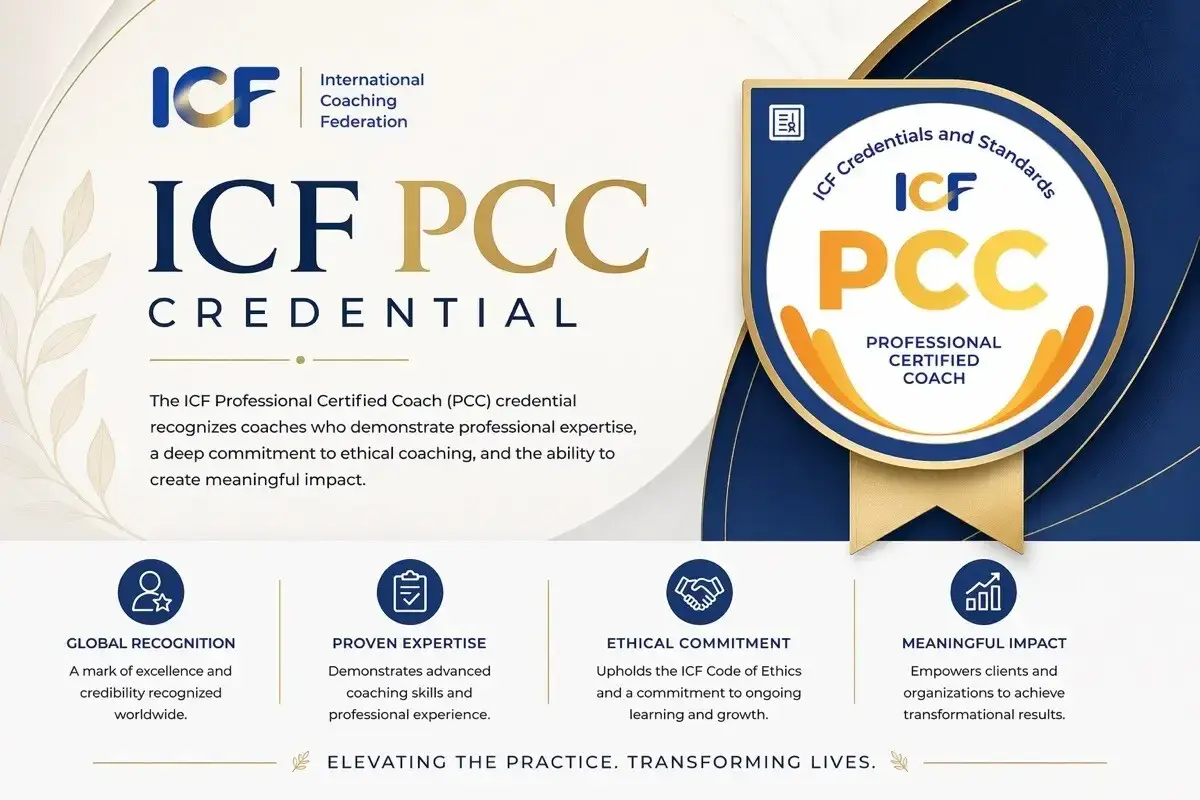
I see the Professional Certified Coach as the point where coaching stops being just a developing skill and starts looking like a mature professional practice. It is an ICF credential, which means it is built around the ICF Core Competencies and the ICF Code of Ethics, not just around how many sessions you have delivered.
That distinction matters. In practice, the PCC credential tells clients and employers that you have gone through a more demanding standard than entry-level coaching. It is not a vanity badge, and it is not a shortcut to authority. It is evidence that your coaching has been tested against a recognised framework and that you can work with more complexity, more nuance, and usually more senior stakeholders.
For a leadership-focused website, this is the part that matters most: PCC is often the level where coaching starts to support real career mobility, whether you are building an independent practice or moving into internal leadership development, executive coaching, or talent roles.
Who it suits best in practice
The PCC is not the right target for every coach, and that is where some people misjudge it. If you are still building confidence, still trying to find your niche, or still collecting your first substantial coaching hours, the PCC can be premature. If you already coach regularly and want stronger professional recognition, it starts to make a lot more sense.
In my view, the credential is especially useful for three types of coach:
- Independent coaches who want a stronger trust signal when selling to organisations.
- Internal coaches, HR professionals, and L&D leaders who want to show that coaching is more than an informal skill.
- Executive and leadership coaches who work with mid- to senior-level clients and need credibility to match the level of conversation.
ICF’s 2025 Global Coaching Study points to a profession that continues to grow, and that growth has a practical side: buyers are more selective. In that environment, a PCC can reduce friction in the sales conversation because it gives prospects one clear reference point instead of a vague promise of experience.
If your work mostly sits at the level of light coaching conversations inside a team, ACC may be enough for now. If you are already handling more difficult behaviour change, identity shifts, leadership transitions, or organisational pressure, PCC is usually the more relevant credential.

How to qualify and apply
The official requirements are more specific than many coaches expect, and that is where careful planning saves time. For the PCC, ICF currently asks for 125 hours of coach-specific education, 500 hours of coaching experience with at least 450 paid hours, 10 hours of mentor coaching, a successful performance evaluation, and a passing score on the ICF Credentialing Exam.
There is also a recency rule on experience. Of those 500 coaching hours, at least 50 hours must be completed within the 18 months before you submit your application. That detail is easy to miss, and it can matter if you took a break from active coaching.
Level 2 path
This route is for coaches who have completed a full ICF-accredited Level 2 programme. It is the cleanest and fastest route for many applicants because the training aligns directly with the credential.
- ICF member fee: $375 USD.
- Non-member fee: $525 USD.
- Estimated review time: about 4 weeks.
Read Also: Internal Coaching - Your Guide to Building a Credible Program
Portfolio path
This route is for coaches with 125+ hours of coaching education that may include a mix of ICF-accredited and non-accredited learning. It offers more flexibility, which is useful if your development path has been pieced together over time.
- ICF member fee: $750 USD.
- Non-member fee: $900 USD.
- Estimated review time: about 18 weeks.
The Portfolio path is not weaker; it is simply slower because ICF reviews the education history more closely. For coaches with older or mixed training, that flexibility can be valuable. For coaches who want speed, the Level 2 route is usually the better option.
The practical takeaway is simple: choose the route that matches your training history, not the one that sounds easiest on paper. That choice usually determines whether the application feels tidy or unnecessarily messy.What it really costs and how long it takes
The application fee is only the visible part of the budget. In reality, the largest costs are usually the training programme, mentor coaching, and the time spent preparing solid recordings and evidence. For UK coaches, the ICF fees are charged in USD, so your final cost will also depend on exchange rates and any provider-specific taxes or billing rules.
| Item | Level 2 path | Portfolio path |
|---|---|---|
| Application fee for members | $375 USD | $750 USD |
| Application fee for non-members | $525 USD | $900 USD |
| Typical review time | About 4 weeks | About 18 weeks |
| Main trade-off | Faster and more direct | More flexible but slower |
There is also a renewal rhythm to keep in mind. PCC holders renew every 3 years and need 40+ Continuing Coach Education credits. That makes the credential feel less like a one-off event and more like an ongoing professional commitment, which is exactly how serious coaching work should function.
If I were budgeting this from the UK, I would not start with the fee. I would start with the time needed to gather clean evidence, get mentor coaching, and make sure the recordings actually show the level of skill the ICF expects.
How it compares with ACC and MCC
The easiest way to understand PCC is to place it between ACC and MCC. ACC is the entry point. MCC is the mastery level. PCC is the stage where a coach is expected to show deeper competence, broader credibility, and more control in complex conversations.
| Credential | Education | Experience | Performance evaluation | Best fit |
|---|---|---|---|---|
| ACC | 60+ hours | 100+ hours | 1 recording | Early-career coaches and professionals formalising coaching skills |
| PCC | 125+ hours | 500+ hours | 2 recordings | Experienced coaches working with more complex client needs |
| MCC | 200+ hours | 2,500+ hours | 2 recordings | Highly experienced coaches aiming for mastery-level practice |
That comparison makes the positioning clear. ACC proves you can coach. PCC proves you can coach at a more advanced level with consistency. MCC shows deep mastery and is a much bigger leap in time and volume. For most coaches who are already established but not yet at expert level, PCC is the sweet spot.
It is also worth saying that PCC is often the credential that matters most in leadership and career-development contexts. ACC can open doors. PCC often helps you walk through them with less explaining.
The mistakes that slow coaches down
I see the same errors come up again and again, and most of them are avoidable.
- People count every helpful conversation as coaching hours instead of tracking only eligible client coaching hours.
- They leave mentor coaching too late and then rush the feedback cycle.
- They choose a training route without checking whether it really supports the application path they want.
- They prepare recordings that are technically fine but do not clearly demonstrate the competencies the evaluators are looking for.
- They forget the 18-month recency rule for part of the coaching experience.
- They underestimate how much admin time an evidence-based application consumes.
The common thread is not lack of ability. It is poor preparation. Strong coaches still get delayed when they treat the process casually. The application rewards clarity, tracking, and honest self-audit much more than it rewards confidence alone.
If you are serious about earning the credential, keep a live log of client hours, client types, paid hours, mentor coaching, and dates. That habit is dull, but it saves a great deal of frustration later.
A sensible move for UK coaches building credibility
For coaches in the United Kingdom, the PCC can be especially useful when your work touches leadership, management, career transitions, or organisational change. Those buyers do not usually want a vague promise. They want proof that you can operate at a professional standard and hold the room when the conversation gets difficult.
That is why I would treat the credential as more than a qualification. It is a positioning tool. If you want to work with executive clients, partner with HR teams, or strengthen your profile in a crowded market, the PCC gives you a sharper story to tell. It also travels well if you work across borders, which matters more in 2026 than it did a few years ago.
If you are planning your next step, start with the route you actually qualify for, then map your hours, recordings, and mentor coaching before you pay any fee. The coaches who move smoothly are usually the ones who treat the process as disciplined professional development, not as a last-minute credential chase. If that is your approach, the PCC becomes a practical career lever rather than just another line on a profile.