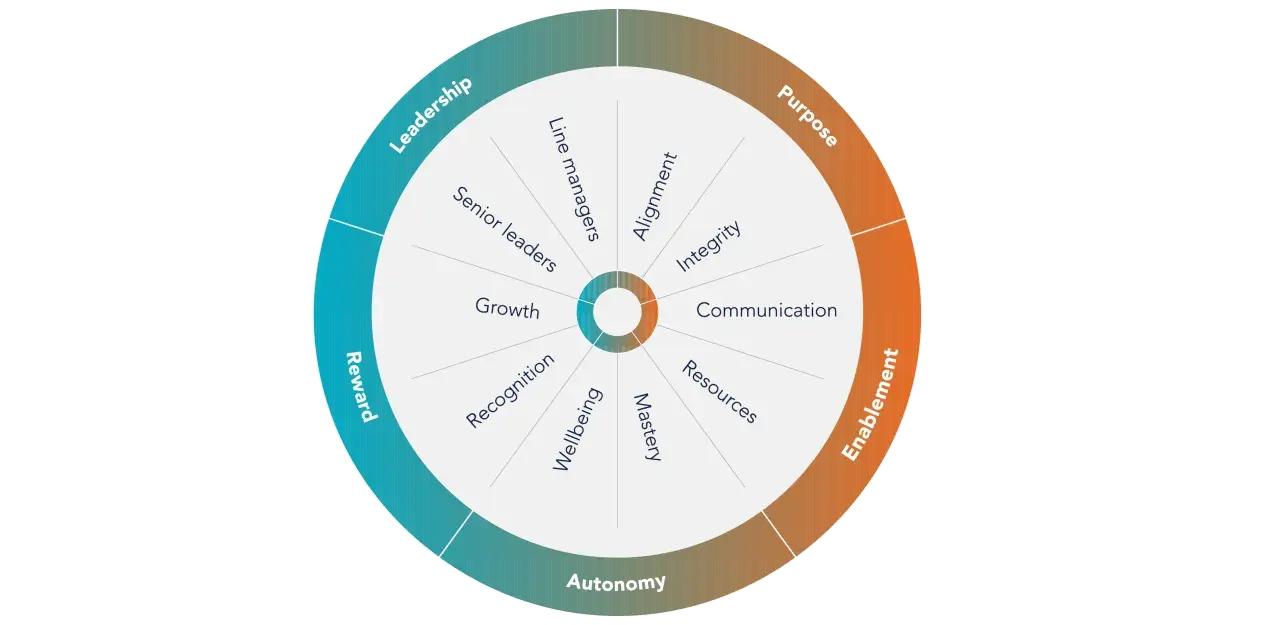
What matters most before you start
- Engagement is a system outcome, not a mood or a perks programme.
- Managers, job design, employee voice and growth shape the daily experience more than slogans do.
- UK data shows many people are engaged in parts of their work, but energy and pressure remain real issues.
- Measure specific drivers rather than relying on one vague overall score.
- A 90-day HR plan is usually more effective than a one-off campaign.
What engagement means when HR owns the problem
I treat engagement as a working relationship, not a feeling. It shows up when people bring energy, attention and judgement to the job because the work feels clear, worthwhile and supported. That is different from simple happiness: someone can like their colleagues and still be disengaged if the role is vague, overloaded or politically messy.
The easiest way to keep the concept useful is to separate a few ideas that often get blurred together.
| Concept | What it looks like | What HR can influence |
|---|---|---|
| Engagement | Energy, dedication and absorption in the work | Job design, manager support, voice, growth and trust |
| Satisfaction | People like parts of the job or the environment | Day-to-day irritants, fairness and basic conditions |
| Commitment | People feel attached to the organisation and want to stay | Purpose, progression, leadership credibility and fairness |
| Motivation | People choose to put effort into the work | Autonomy, meaningful goals, recognition and development |
The practical lesson is straightforward: HR should not chase a warm feeling. It should build conditions that make the right behaviour easier and the wrong friction smaller. Once that is clear, the next question is why the issue matters so much.
Why it matters for performance, retention and wellbeing
The business case is real, but it is not magic. The CIPD's Good Work Index suggests around half of UK workers feel enthusiastic and immersed in their roles, yet only about a third feel full of energy at work. At the same time, roughly one-fifth report exhaustion or excessive pressure. That tells me engagement and wellbeing travel together: when work is badly designed, people can still look busy while their commitment quietly thins.
For HR, the value of engagement usually appears in five places:
- Retention, because people are less likely to leave roles that feel meaningful and manageable.
- Productivity, because clarity and commitment reduce wasted effort.
- Customer experience, because engaged teams tend to be more responsive and consistent.
- Innovation, because people share ideas more freely when they feel safe and listened to.
- Health and safety, because pressure, fatigue and disengagement often travel together.
There is also an important caution here. Engagement is not a straight line from a happy survey score to better results. Performance and engagement influence each other, and the effect is usually stronger at team level than at whole-organisation level. In plain terms, better performance can lift engagement, but engagement is also shaped by whether people have the tools, time and support to perform in the first place. That is why the levers matter more than the slogan.
The HR levers that actually move the needle
I do not think of engagement as an HR-only project. Senior leaders set direction, managers shape daily reality, and the operating model either supports good work or frustrates it. The strongest programmes are usually a series of connected decisions, not one grand campaign.
Get the job itself right
Engagement rises when work feels understandable, manageable and meaningful. Autonomy matters because people are more willing to invest in a role they can shape. If work is overloaded, poorly sequenced or full of avoidable handoffs, no amount of recognition can fix the basics.
In practice, that means reviewing workload, clarifying priorities, trimming unnecessary approvals and making success criteria explicit. I would rather remove one painful process than launch a dozen perks that nobody asked for.
Make managers the daily multiplier
Managers shape the employee experience more than policy documents do. They translate strategy into priorities, feedback, pace and fairness. A strong manager does not need to be charismatic; they need to be clear, consistent and available enough to notice when someone is drifting.
Good engagement practice here is unglamorous but effective: regular one-to-ones, useful coaching, timely recognition, honest conversations about workload and early intervention when standards start to slip. If managers are undertrained or overloaded, they cannot carry this role by instinct alone.
Build employee voice that changes decisions
Employee voice is the ability to express views and influence matters at work. That means more than an annual survey. It includes pulse checks, listening groups, skip-level conversations, team retrospectives and open speak-up channels.
The part many organisations miss is the response. A speak-up culture is built by action, not slogans. If people share feedback and nothing changes, trust falls quickly. Psychological safety, meaning people can speak without fear of humiliation or retaliation, is the difference between honest input and polite silence.Read Also: Employee Listening - Stop Guessing, Start Acting
Link growth, recognition and fairness
People stay engaged when they can see a future for themselves. Learning and development matter because they signal movement, not stagnation. Internal mobility, transparent progression and specific recognition often do more than generic praise ever will.
Fairness matters just as much. If pay, promotion or workload decisions feel arbitrary, engagement drops even in otherwise healthy teams. I also pay attention to person-job fit here, because the wrong person in the wrong role will often look like a motivation problem when it is really a design problem.
Once those levers are aligned, measurement becomes more useful because you are tracking something you can actually improve.
How to measure it without fooling yourself
I am wary of engagement programmes that collapse a complex experience into one flashy score. Composite numbers are easy to present and hard to act on. If the figure changes and nobody can say what to fix, the metric is decorative.
My preferred approach is layered and specific.
| Method | Best for | Limitation |
|---|---|---|
| Annual survey | Organisation-wide baseline and trend tracking | Too slow if used on its own |
| Monthly pulse | Tracking a few drivers such as workload or manager support | Can become noisy if overused |
| Focus groups and interviews | Understanding the reasons behind the numbers | Smaller sample, needs good facilitation |
| Manager check-ins | Spotting issues early at team level | Inconsistent unless managers are trained |
| People analytics | Linking engagement to turnover, absence and promotion data | Shows patterns, not feelings |
If you want a reliable engagement measure, use a short, established tool such as the three-item Utrecht Work Engagement Scale, then add a few questions tied to your real drivers: workload, manager support, voice and development. The point is not to measure everything. The point is to measure the things you can change.
I would also segment the results by team, location, tenure and manager. Averages hide too much. A company can look fine on paper while one part of the organisation is quietly burning out. That is where a practical HR plan earns its keep.
What a practical HR engagement plan looks like in a UK workplace
ONS data shows that 28% of working adults in Great Britain hybrid worked between January and March 2025, so any credible engagement plan now has to work across office, home and frontline settings. I prefer a 90-day rhythm because it forces prioritisation and gives people time to see visible change.
- Days 1 to 30, diagnose the friction. Review survey themes, turnover, absence and exit data. Run a few listening sessions with different groups. Look for the three most common blockers, not thirty.
- Days 31 to 60, fix manager basics. Give managers a simple check-in structure, clearer escalation routes and guidance on workload conversations. In hybrid teams, define how updates, decisions and availability should work so people are not guessing.
- Days 61 to 90, close the loop. Communicate what will change, what will not change and why. Launch one visible development action, such as internal mobility steps, mentoring or role-based learning. Then recheck the same few measures.
If I were building this for a UK organisation, I would keep the messaging plain and specific. People do not need an abstract promise that “engagement matters.” They need to see which meeting rules changed, how managers will now handle workload, and what happened to the feedback they gave last quarter. That is what turns strategy into credibility.
The mistakes that quietly kill engagement
Most engagement failures are not dramatic. They are ordinary and repetitive.
- Running surveys without follow-through. Asking for honest feedback and then disappearing is one of the fastest ways to damage trust.
- Confusing perks with progress. Free coffee is not a substitute for clarity, workload control or development.
- Training managers once and hoping for the best. Manager behaviour changes with practice, coaching and accountability, not a single workshop.
- Using one message for every team. Frontline, office and hybrid staff often experience the organisation very differently.
- Ignoring overwork. Persistent pressure can make people look committed while steadily eroding commitment.
- Hiding behind broad scores. If the metric does not tell you what to do next, it is too vague.
These mistakes usually come from weak systems, not bad intent. Once that is accepted, the priority becomes choosing where to invest first instead of trying to fix everything at once. That brings me to the handful of moves I would make before anything else.
What I would prioritise first in 2026
If I were advising a UK HR team this year, I would start with three things: strengthen manager capability, simplify the work that makes people feel stuck, and create a visible response loop after every piece of feedback. Those three are less glamorous than a new platform or a big internal campaign, but they are far more likely to change daily experience.
From there, I would build one or two measures that can be reviewed monthly, not once a year, and make sure leaders can name exactly what changed because of the data. That is the point where engagement stops being an HR initiative and becomes part of how the organisation runs. When HR gets that right, people usually do not just stay longer; they work with more energy, more judgement and more trust.