Coaching is most useful when you already have capability but need clearer thinking, stronger follow-through, or a better way to navigate change. This article explains how coaching works, why people invest in it, where it fits in a UK career or leadership journey, what it costs, and how to choose someone who will challenge you in the right way.
What coaching really gives you is clearer thinking, stronger follow-through, and better decisions
- Coaching is a future-focused, one-to-one process that turns goals into action.
- It is strongest when you need accountability, perspective, and behavioural change, not just advice.
- In the UK, coaching is common in career development, leadership growth, and transition periods.
- Prices vary widely, from roughly £40-£60 an hour for newer practitioners to £150-£450 per session for established coaches.
- A good coach does not tell you what to do; they help you think more clearly and act more deliberately.
Why coaching helps people move when self-help stalls
I usually separate coaching from generic advice in one simple way: advice tells you what someone would do, while coaching helps you see what you will actually do. Gov.UK frames coaching as one-to-one support that improves performance and helps people work toward a goal, but the real value is more practical than that. Good coaching gives you a sharper view of the problem, then holds you to action.
- It creates self-awareness. You start to notice the assumptions, habits, and blind spots that keep the same issue repeating.
- It adds accountability. A goal sounds different when you know someone will ask what happened between sessions.
- It turns vague ambition into action. Many people already know what they want in general terms; coaching makes the next step concrete.
- It builds self-reliance. The point is not dependency on the coach, but better judgement and stronger ownership.
- It can unlock performance under pressure. When the pace of work is high, a calm external perspective often exposes the fastest route forward.
That mix of insight and accountability matters because many talented people do not need more information; they need a cleaner decision and a better habit of execution. Once you see that, it becomes easier to spot the situations where coaching is the right tool.
The situations where coaching is most useful
In my experience, coaching is most valuable when the problem is not a lack of ability but a lack of clarity, consistency, or confidence. That is why it shows up so often in leadership development, career progression, and change management. The UK coaching market reflects that need, especially in workplaces that want people to grow without waiting for a formal training course.
- You are stepping into a new role. Moving from specialist to manager, or from manager to leader, changes what good performance looks like. Coaching helps you stop solving every problem yourself and start leading through others.
- You know you want a change, but the plan is fuzzy. A coach is useful when you have a direction but not a path. The conversation can turn a broad wish into a sequence of decisions.
- You have lost confidence after a setback. A promotion miss, a difficult restructure, or a public mistake can shrink your sense of what is possible. Coaching helps restore perspective without pretending the setback did not happen.
- Your communication is costing you time or trust. If meetings feel tense, feedback is not landing, or people keep misunderstanding you, coaching can expose the patterns behind the friction.
- You are capable but stuck in overthinking. Some people do not need more options; they need a way to choose, commit, and move.
- You need to perform through change. Reorganisations, hybrid work, and shifting expectations all reward people who can adapt quickly without losing focus.
Those are the common use cases; the next question is how coaching differs from the other kinds of support people often lump together.
How coaching differs from mentoring, therapy, and training
Because the boundaries get blurred quickly, I like to compare these approaches directly. Coaching is future-focused and non-directive; mentoring is more experience-led; therapy addresses emotional health; and training teaches a defined skill. Once you know the difference, you are far less likely to pay for the wrong kind of help.
| Support type | Best for | How it works | Main limitation |
|---|---|---|---|
| Coaching | Clarifying goals, improving performance, changing behaviour | Questions, reflection, accountability, action planning | Needs openness and follow-through from the client |
| Mentoring | Learning from someone who has already done the job | Advice, shared experience, shortcuts, context | Can become too prescriptive if the mentor dominates |
| Therapy | Emotional healing, mental health concerns, deeper personal work | Clinical or therapeutic methods, often exploring the past and present | Not designed as a performance tool for work goals alone |
| Training | Learning a specific skill or process | Structured teaching, practice, and assessment | Less personalised and less adaptive to one person's situation |
That comparison matters because coaching is not a magic label for every kind of support. If you want expert advice, mentoring may be better. If you need clinical help, therapy is the correct path. If you need a new skill fast, training is the most direct route. Coaching sits in the middle when the real task is to think better, choose better, and act better.

What a coaching session actually looks like
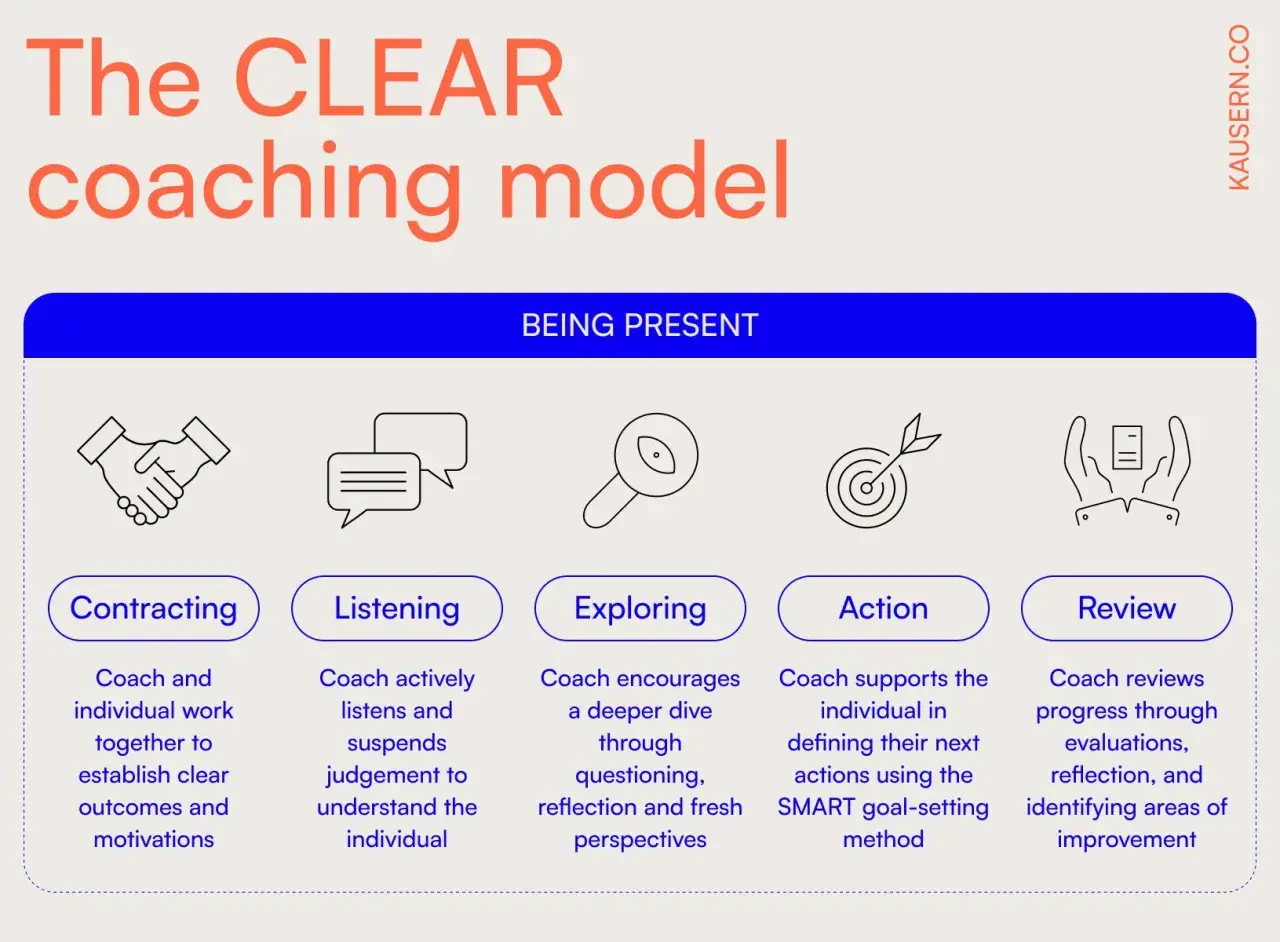
Most sessions run between 30 and 60 minutes. The coach usually starts by reviewing what happened since the last conversation, then narrows the focus to one priority, asks open questions, and ends with a clear action. That structure keeps the work practical, which is why coaching feels less like a motivational chat and more like disciplined thinking.
- Bring one concrete issue. A focused session is more useful than a vague conversation about everything that feels hard.
- Expect questions, not lectures. A good coach will not rush to rescue you with answers. They will help you test your own thinking.
- Be honest about the constraint. If time, confidence, politics, or energy is the real blocker, name it early.
- Leave with one action. The best sessions end with something you can actually do before the next meeting.
- Do the work between sessions. Coaching is not just what happens in the room; the behaviour change usually happens in the days after it.
I think this is where a lot of people misread the process. They expect insight to be the outcome, when in practice insight is only useful if it leads to a decision, a conversation, or a different habit.
What coaching costs in the UK and when it is worth paying for
Price is one of the most common reasons people hesitate, so it helps to look at the market honestly. In the UK, Prospects places newer private coaches around £30 to £75 an hour, experienced coaches around £100 to £200 an hour, and established executive or corporate coaches above £250 an hour. For a 45 to 60 minute session, fees of £150 to £450 are common for well-established coaches.
| Coach level | Typical UK price | Best fit | What to watch |
|---|---|---|---|
| Newer coach | £30-£75 per hour | Testing coaching without a large commitment | Ask about training, supervision, and experience |
| Experienced coach | £100-£200 per hour | Career, leadership, and confidence work | Check how progress is measured |
| Executive or corporate coach | £250+ per hour or £150-£450 per session | Senior transitions, high-stakes decisions, organisational change | Price alone does not guarantee fit |
Coaching is worth paying for when one of three things is true: a better decision will save time or money, a transition is too important to improvise, or accountability will help you actually follow through. It is usually a poor fit if you only want quick advice, if you are not prepared to do work between sessions, or if the real issue is mental health rather than performance. That is a useful boundary, not a criticism of coaching.
How to choose a coach who is worth your time
Because coaching is unregulated in the UK, I would be careful about choosing on confidence or branding alone. The better question is whether the coach has a clear niche, a visible method, and enough experience to help with the exact problem you have. A polished website is not a substitute for fit.
- Look for a relevant specialism. Leadership coaching, career coaching, and confidence work require different strengths.
- Ask how they work. A serious coach can explain their process without hiding behind jargon.
- Check training and credentials. Qualifications are not everything, but they matter more when the profession is unregulated.
- Ask how they measure progress. You want someone who can define what improvement looks like in practical terms.
- Notice how the first conversation feels. Good coaching should feel safe enough to be honest, but direct enough to challenge you.
- Pay attention to boundaries. Confidentiality, cancellations, and session length should be clear before you commit.
I also look for one small sign that is easy to miss: does the coach make the next step sound simpler, or just more impressive? The best ones reduce noise. They help you see the problem more cleanly and act with less friction.
What good coaching should leave you with
After a few sessions, good coaching should be visible in the way you think and the way you behave. You should have clearer priorities, a more stable sense of ownership, and better choices under pressure. In workplaces, that often shows up as stronger leadership, better conversations, and fewer stalled decisions. For an individual, it often feels like less mental clutter and more forward motion.
If coaching is working, you will not only feel encouraged. You will know what matters, what to do next, and how you will know whether you are getting anywhere. That is the real test I would use before calling any coaching relationship successful.